
With almost 50% of the world’s population using some form of social media, taking the leap and putting your business online was the right decision.
But once you’ve created your profiles and bulked out your ‘About Us’ sections, it can be difficult knowing what to do next. Whilst your instinct may be to start posting anything and everything in the hope that something will gain traction, we’d recommend taking a step back and first building a social content plan.
At 10X Marketing, we like to plan our social content out in 4- to 6-week blocks, as it helps to create direction and give consistency to our social platforms.
As someone new to social media marketing, creating 6-weeks’ worth of content up front may seem like a daunting (and borderline impossible) undertaking, but if you take the time to answer some of the following questions and conduct the relevant research, you’ll soon have a significant list of ideas to play around with.
Building content ideas
What would your customers like to see?
Like with emails, paid ads, print marketing etc., it’s vital that your social media content fits to your buyer persona. Therefore, the best place to start is with the customer.
When you first put pen to paper, ask yourself (or your colleagues) the following:
- What common problems do our customers face which we can help answer?
- What useful tools and resources can we offer them?
- What relevant industry news can we share with them?
Put yourself in your target audience’s shoes and imagine what you would like to see most come up on your timeline. And if you really aren’t sure, don’t be afraid to ask your customers directly.
What are your competitors posting?
A great place to gain inspiration for your own social media posts is to carry out a competitor analysis. Start by creating a list of your biggest competitors and then ask yourself the following:
- Which social media posts of theirs seem to be the most popular? The number of likes, comments and shares is a relatively good indication of this.
- What makes these posts so engaging? – Do they have a strong call-to-action? Have they used effective visuals?
- How do their customers respond and engage with their posts?
- How do they engage with their customers?
Completing a customer analysis can be a useful springboard to creating your own content, and to measuring your success.
As Hootsuite puts it, “A competitive analysis allows you to understand who the competition is and what they’re doing well (and not so well). You’ll get a good sense of what’s expected in your industry, which will help you set social media targets of your own.”
What categories can my business be split up into?
Categorising your business into sections can help massively with content creation.
At 10X Marketing, we focus on 5 different areas of content marketing which means that, if we create one content idea for each area, we already have 1-weeks’ worth of weekday content.
When looking at your own business and what products or services you offer, think about the ways in which you could categorise your business. If we were to use a florist as an example, you could split this into the following categories:
- Wedding flowers
- Funeral and sympathy flowers
- Occasion flowers – Valentines’ day, Mother’s Day, Anniversaries
- Everyday flowers
- Dried flowers
- Flower arranging
- Flower and plant care
- Indoor plants
- Outdoor plants
- Vases and plant pots
All of these ‘main’ categories can then be sub-divided further into more specific categories. Take ‘Wedding flowers’ for example, this can be divided into:
- Bride and bridesmaids’ bouquets
- Groom and groomsmen’s boutonniere
- Alter and aisle decorations
- Reception centrepieces
- Cake table arrangements
If you were to repeat this process for all of your original 10 categories, you’d end up with 50 content topics.
These could then be topped up further with more generalised content such as customer testimonials, meet the team posts, uplifting quotes, memes and ‘funnies’, and general business updates.
Writing social media captions
Once you’ve got your content categories and rough ideas listed, it’s time to write your caption copy.
Regardless of what you are writing about, the ultimate aim of a caption should be to educate, entertain, or create a particular emotion within the reader (you can of course directly promote your brand too, but we’d recommend doing this less frequently – the ‘80/20 rule’ works well for this).
First and foremost, you want to decide on the intention of your post: are you trying to connect with your customer? Are you wanting them to follow a specific call-to-action (such as visit your website)? Are you wanting to showcase your brand’s personality?
If we once again return to the florist example and specifically the ‘reception centrepieces’ sub-category – you may find a common question you get asked by customers is ‘What are the best flowers for a long table?’. Simply use your caption to answer this common question and educate the reader.
You also want to ensure that your caption encourages conversation, and the best way to do this is by asking open-ended questions. By asking ‘What centrepiece flowers are you planning to have at your reception?’ at the end of your caption, you’re actively encouraging the reader to engage with your post, which will help boost your engagement rating.
Choosing your social content format
Catching and sustaining your target audience’s attention on social media can be difficult with so much content uploaded each day (on Facebook, 684,478 pieces of content are uploaded per minute).
But there are ways that you can ensure that your content does stand out from others, and that’s with visuals.
According to Twitter, adding video, links and photos to your social posts all result in an impressive boost in the number of Retweets, and this is shared across all of the major social media platforms. Social media strategist Jeff Bullas reports that the engagement rate on Facebook for photos is 37% higher than plain text posts.
Whilst some industries will find it easier to create and share relevant images (if we go back to the florist example, being surrounded by beautiful flowers will make this much easier), graphic design platforms such as Canva give those in any industry (and with zero graphic design skills) the opportunity to create a host of engaging social media graphics from ready-made templates.
Social media posting frequencies and times
Many marketers have tried to answer the age-old question of ‘how often should I post to social media?’, and most have come up with varying results. Based on a combination of research and our own trial-and-error process at 10X Marketing, we think the following is a good rule of thumb…

Remember though, this is simply a recommendation. If you are a small company and do not have the capacity to create more than 3 Facebook posts a week, start there and you can build up as your business grows. The more you post and experiment with timings, frequency and even content topics, the easier it will be to know what is right for you and your business.
Creating a social media content calendar
Now that you’ve got your content and rough posting schedule mapped out, it’s time to pull it all together into a content calendar. There are various tools and resources you can use for this, but we think the easiest (and cheapest) option is to create a calendar using Microsoft Excel.
Not sure how best to lay out your calendar? We’ve created a free downloadable version which you can start using instantly. It has a tab dedicated to each of the main social platforms, recommended posting times for each day of the week, and a list of content ideas and prompts to help get you started. Download your copy here.
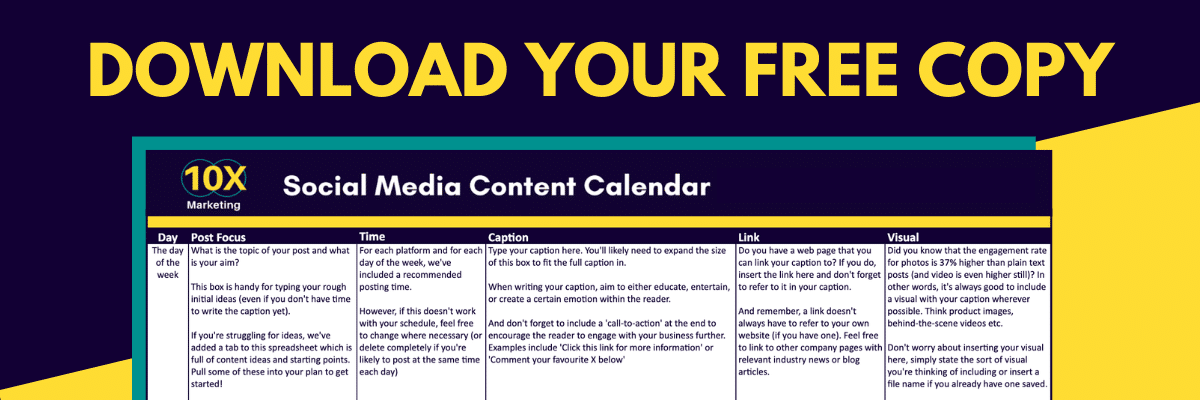
Having everything in one place makes it easier for you to keep on top of your content if you do not have access to marketing automation software.
But don’t worry, mapping out your content doesn’t mean it cannot be changed or tweaked as you move along the 6-week period. The best brands are those that adapt to the ever-changing needs and challenges of their customers, and therefore you can still re-share posts that pop up on your feed and create posts based on recent and relevant news articles.
If you’d like help putting together a content calendar or wider social media marketing strategy for your business, reach out to us at 10X Marketing. We’d be happy to help!