Many businesses invest in content marketing… and end up with one thing: traffic.
Now, traffic is great. We love it as much as the next person. But without a clear way to capture and convert that attention, it rarely turns into tangible revenue for your business.
And while content marketing can be incredibly effective – companies that prioritise content marketing generate 3x more leads at 62% lower cost than outbound marketing – the reality is that most businesses aren’t seeing those kinds of results.
So, what’s missing?
A lead-focused content marketing strategy.
In this post, you’ll discover five content marketing strategies that don’t just attract visitors to your website but turn those visitors into leads – as well as practical tips on how to execute each of them effectively.
Why most content marketing fails
Most content marketing doesn’t fail because of a lack of effort – it fails because of a lack of strategy.
And more often than not, it’s because that strategy is built around visibility, not conversion.
Common issues include:
- Focusing on traffic instead of conversions
- No clear lead magnets or calls-to-action
- Weak (or non-existent) email follow-ups
- Disconnected content that doesn’t align with the buyer’s journey.
The result? Visitors come… and then they leave.
A strong content marketing strategy should be designed around lead generation, not just visibility; it should guide users from discovery through to decision.
Strategy #1: SEO blog content that converts
Not all blog content is created equal.
The key to effective SEO content marketing isn’t just ranking; it’s targeting the right intent.
For example, a Google search of “What is a CRM?” might have high traffic, but it brings low buyer intent. Whereas a search for the “Best CRM for small businesses” might have lower traffic, but it brings high buyer interest and intent.
This second option is far more likely to generate leads.
To turn your blog traffic into enquiries:
- Include clear CTAs (download, book, enquire)
- Embrace inline forms or gated content
- Build content clusters around your service pages to strengthen authority.
Done right, blog content becomes a core part of your lead generation content marketing strategy – not just an awareness tool.
Strategy #2: Lead magnets & downloadable content
If you’re not actively capturing the contact details of site visitors, you’re leaving money on the table.
Lead magnets are how you turn anonymous traffic into known prospects. They’re the point where your content starts generating measurable value.
It involves your audience inputting their information – name and email address, for example – in return for a piece of value-adding content.
Examples include:
- eBooks
- Templates
- Checklists
- Industry reports.
This is where your content marketing strategy shifts from passive to proactive – actively building a pipeline of qualified leads.
Strategy #3: Landing page content that converts
Landing pages are where conversions happen.
Without them, your content has nowhere to direct users to take action.
High-performing landing pages typically follow the same structure:
- A clear, benefit-led headline
- Problem-focused copy
- Strong social proof (testimonials, results)
- A single, focused call-to-action.
They should be tightly connected to your wider content marketing – particularly blog content and lead magnets.
Think of landing pages as the bridge between interest and action.
💡 Want to see how this could work for your business?

Strategy #4: Email marketing
Capturing a lead is only the beginning.
Email marketing is what turns their initial interest into trust – and that trust into conversion.
Effective nurture sequences might include:
- Welcome emails
- Educational content
- Case studies and success stories
- Timely offers or next steps.
The key is relevance. So, segment your audience based on their:
- Interests
- Behaviour
- Stage in the buyer journey.
Effective email marketing ensures your content continues working long after the first interaction.
Strategy #5: Case studies & content to build authority
When it comes to decision-making, proof matters.
Case studies and authority content show potential clients what you’ve done, who you’ve helped, and what results you’ve achieved.
Examples might include:
- Detailed client success stories
- Before-and-after results
- Comparison content.
For B2B content marketing services, this type of content is essential as it builds credibility and reduces risk in the buyer’s mind.
It answers the key question: “Will this work for me?”
How these strategies work together
Individually, these approaches are powerful.
Together, they create a complete lead generation system:
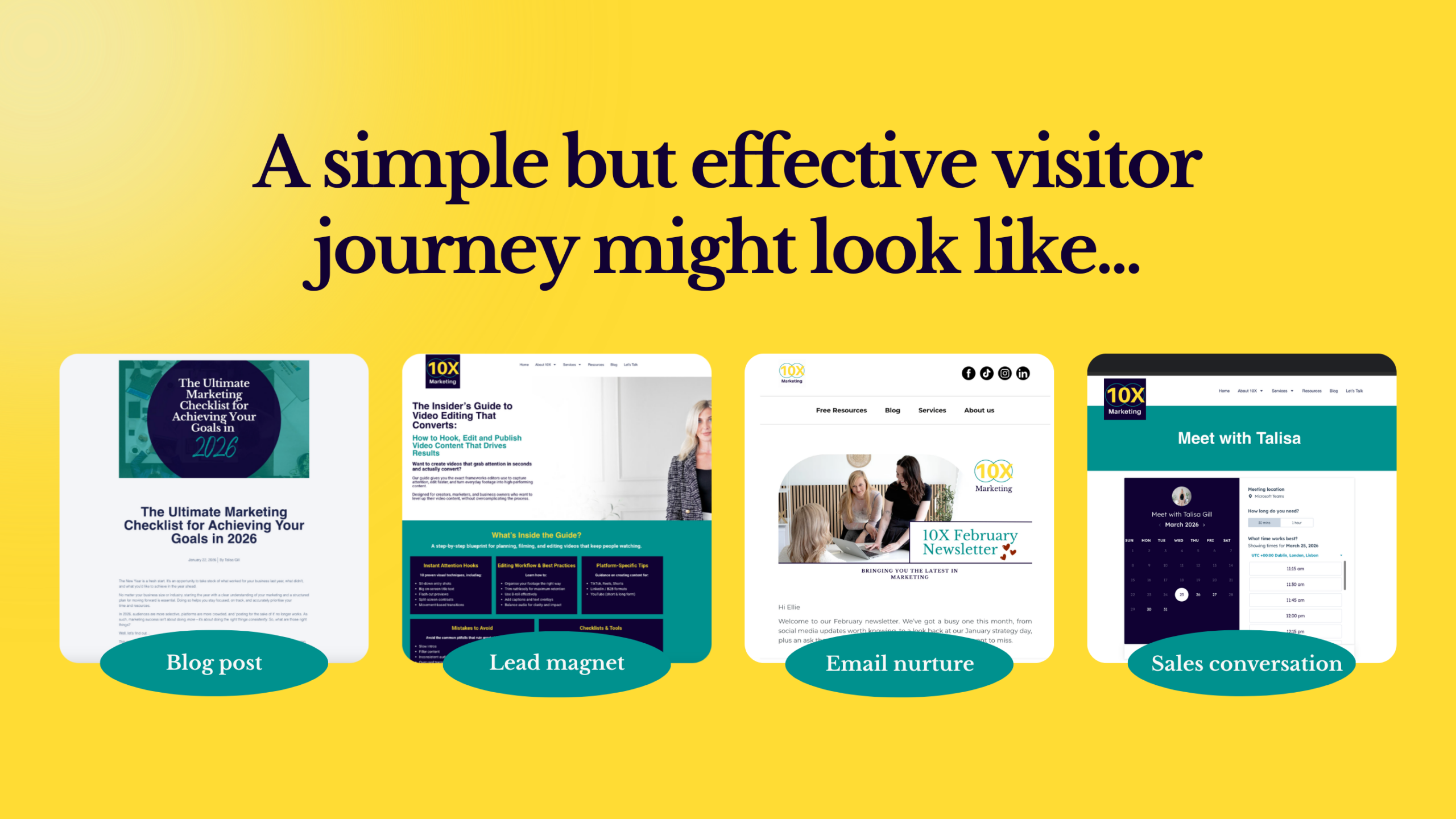
Blog → Lead magnet → Landing page → Email nurture → Sale
This is where many businesses go wrong – treating content as isolated elements rather than an interconnected system.
As explored in our guide to aligning your sales cycle with the customer journey, the most effective marketing strategies meet buyers at every stage – from awareness through to final decision.
Content marketing isn’t just about posting and hoping for the best. It’s about guiding.
Take your marketing up a notch
Content marketing shouldn’t just drive traffic – it should generate measurable leads and revenue.
By combining:
- SEO blog content
- Lead magnets
- Landing pages
- Email nurture sequences
- Case studies
…you create a predictable, scalable system for growth.
If your current content isn’t delivering leads, it’s not a content problem – it’s a strategy problem.
Want to fix it once and for all?
At 10X Marketing, we work with businesses like yours to create long-term marketing strategies that yield real results. To adopt a more proactive, lead-driven approach, get in touch with us today.
Want even more marketing support? Have a browse of our free downloads!